Introduction
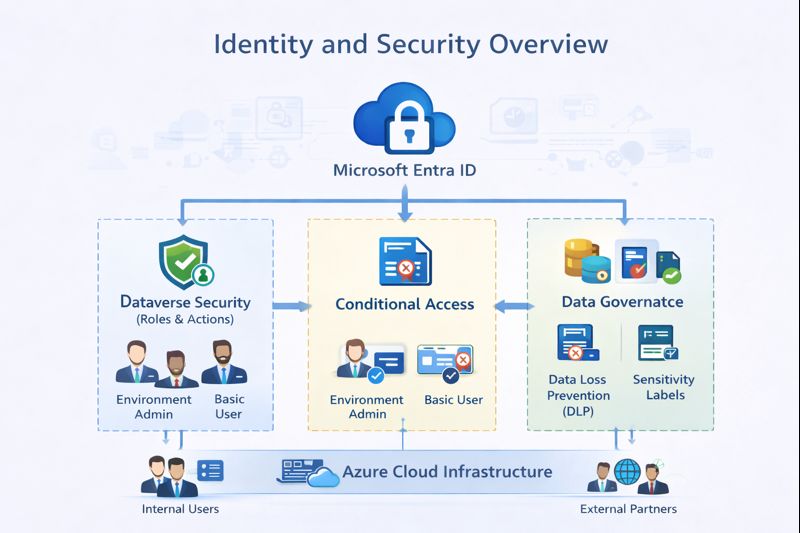
Dataverse security is additive, layered runtime evaluation model. The layer constitutes of:
- Identity
- Environment Access
- Business Units
- Security Roles
- Team Membership
- Record Ownership
- Record Sharing
- Access Teams
- Field-level sharing
- Hierarchy Security
It is not:
- A simple RBAC system
- Instantly predictable without modelling
- UI-only
- enforced at single layer
Why Dataverse Security Exists
Dataverse security is designed for enterprise CRM scenarios and exists to:
- Enforce least privilege
- Support complex organization models
- Enable record level collabrations
- Scale across department and geographies
Core Concepts
- High-Level Security Evaluation Flow
text
Request(UI/API/Flow/Plugin)
        |
Identity Authenticated (Entra ID)
        |
Environment Access Check
        |
Security Role Privileges
        |
Business Unit Scope
        |
Ownership/Team Ownership
        |
Access Team Membership
        |
Field Level Security
        |
Allow or Deny
- Business Units
Business unit should be used for structural seperation not collabration.
What Business Units Do
- Define data visibility boundaries
- Scope security role privileges
- Influence reporting and ownership
They do not:
- Grant permission by themselves
- Replace teams
Common BU Failure pattern
text
Single BU
  |- Hundreds of roles
      |- Excessive sharing
          |- Performance degradation
- Security Roles
What Roles Define
Security roles define:- CRUD privileges
- Privilege depth (User/BU/Parent-Child/Org)
- Entry-level access
Roles do not:
- Grant access without records
- Override BU boundaries
Role Explosion Anti-Pattern
- One role per scenario
- Minor variations duplicated
- Hard to maintain
Better Pattern
- Base roles + additive roles
- Ownership Model
User-Owned Records
- Default for transactional data
- Subject to BU and role scope
- Requires sharing for collabrations
Team-Owned Records
- Owned by Owner Teams
- Access governed by team roles
- Useful for queues, shared workload
- Teams in Dataverse Dataverse supports two fundamentally different team types
- Owner Teams
What they are
- Can own records
- Can have security roles
- Behave like users for ownership
Use When
- Shared ownership is required
- Records belong to a group, not a person
Risks
- Overuse leads to ownership ambiguity
- Access Teams
They exists to solve one problem:
- Temporary, record-level collabration without sharing explosion
What they are:
- Record-specific access control
- No ownership
- No security roles
- Access granted via team templates
- How Access Team Works?
text
Record
  |- Access Team Template
      |- User A (Read/Write)
      |- User B (Read)
      |- User C (Append)
- Teams are created dynamically per record.
- Membership controls access
- Security role still required at base level
What Access Teams Can and Cannot Do
| Capability | Access Team |
|---|---|
| Own records | No |
| Have security roles | No |
| Grant record access | Yes |
| Replace sharing | Yes |
| Replace BU | No |
| Replace roles | No |
Good vs Bad Use of Access Teams
- Good Use
- Case collabration
- Opportunity deal teams
- Temporary reviewers
- Approval participants
- Bad Use
- Permanent access control
- Replacing security roles
- Organization-wide visibility
- High volume batch updates
text
Access Team created
        |
Users lack base table privilege
        |
Access appears broken
Access team augements access- they never replace base privilige.
- Sharing
What sharing does
- Creates explicit access entries
- Overrides ownership boundaries
- Adds runtime evaluation cost
When Sharing Becomes a Problem
- Thousands of shared records
- Frequent share/unshare operations
- Cross-BU collabration without design
If share is required often, redesign security
- Field Level Security
Purpose
- Protect. sensitive columns
- Override, table-level access
Field level security doesnot secure records, it only secure columns.
Role-Based Perspective
Admin
- Responsibilities
- BU design
- Role governance
- Team strategy
- Sharing Limits
- Performance monitoring
- Common Failure
- Overusing sharing
- Ignoring Access teams
- Creating too many roles
- No security design documentation
Architect
- Key Decision
- BU strategy
- Role composition
- Owner vs Access Teams
- Sharing vs Access Teams
- Performance vs flexibility trade offs
- Failures
- Designing security bottom-up instead of top-down
Developer
- Reality
- Security failures appear as "no data"
- API calls silently trimmed
- Plugins run under specific identity
- Failures
- Testing as System Admin
- Ignoring Access Teams
- Assuming read=write
- Hardcoding ownership assumptions
User Experience
- Record visible but not editable
- Record disappeared but visbile for other user
Best Practices
Do
- Design security before schema
- Use Access Teams for collabration
- Limit explicit sharing
- Keep roles minimal and composable
- Document security design
Don't
- Test only as admin
- Overuse owner teams
- Ignore BU boundaries
- Grant System Administrator casually
- Treat Access Team as magic
Common Mistakes
- Roles Control Everything
- Role define potential access, not actual access
- Access Teams Grant Permissions
- They grant access only if base privilege exists
- Sharing is fine at scale
- Sharing is hidden performance tax
Summary
Dataverse security:
- is layered and cumulative
- Requires design, not trial-and-error
- Trades flexibility for complexity
- Scales only when patterns are intentional
Access Teams:
- Are essential for collabration
- Prevent sharing explosions
- Are often underused
- Require correct base privilege